Arriving
We ate noodles in a non-descript restaurant in Chengdu Airport and waited, listening to announcements for departures to Chinese cities: Shenyang, Chongqing, Guiyang; great sprawling places of modern efficiency. But then the voice over the loudspeaker announced the flight from Lhasa had arrived. Lhasa!
I watched passengers filing off the Lhasa flight: wind-burned faces, some shaggy-haired with darker skin, black leather jackets; one or two were stopped to have their IDs checked. There were Chinese tourists with SLR cameras and a lone People’s Liberation Army soldier wearing fatigues and desert boots. Behind them the aircraft kept its jet engines spooling, its fuselage was covered in dust and had several dents. It had been on a voyage of fantastical places that morning; not just Lhasa, an app told us, but also Kathmandu and Shangri-La. My partner and I were about to board this plane. But it would take us not to off-limits Lhasa but a lesser-known outpost of Tibet, a place called Xiahe.
When an airline employee shouted “Xiahe!” it brought a line of colour from the grey departures lounge: Buddhist monks in dark maroon robes, Hui Muslims in patterned skull caps, Tibetans wearing cowboy hats and bright woollen cardigans. There were several lone Chinese, mostly men with neat haircuts wearing short shirt sleeves. We laid down our chopsticks and joined this line.
Soon the plane was shuddering up through the thick smog of Chengdu, eventually breaking free of the grey and smoothing out above whiter cloud. We were seated around a group of monks and exchanged smiles but did not speak; I was unsure which language to use.
Cartographically, Chengdu lies roughly in the middle of China but in reality it is a frontier; the first or last Han Chinese city. To the west lie the huge expanses of Tibet and Xinjiang, places relatively recently brought under the Chinese flag. Within China these places are largely portrayed as holiday destinations or as far-off postings for those employed in certain industries (government, military, mineral extraction, hydrology). And with their Chinese names (Tibet is Xizang in Chinese) and Chinese infrastructure they are thought of as a part rather apart. But what is undeniable as you travel west or north of Chengdu is the very different geography and the very different ethnicities and cultures which emerge. As we distanced ourselves from Chengdu, the cloud thinning and snowy mountain peaks appearing outside the window, I felt happy to be heading in this direction.
The smoothness of the flight did not last. Rising air from the mountains began buffeting the aircraft. There were bumps of turbulence then one wing suddenly dipped providing views straight down to the bare mountain bases and snowy summits before rolling back the other way. At one point the aircraft suddenly plunged, taking the wind from my stomach, and causing some gasps from the cabin before the engines whined to regain lost height.
But most were sanguine about the turbulence. One Buddhist monk pressed his face to the window, another was filming the unravelling mountains on his mobile phone. A particularly large monk sitting in a middle seat was quietly reciting mantras, eyes shut, counting his rosary beads. His enormous size was squashing a Chinese man in the window seat who was immersed in a war film on his phone and who seemed oblivious to the large, holy presence next to him. Beautiful Chinese flight attendants made one daring attempt with the drinks trolley before retreating to their seats, apologising for the cancellation of refreshments.
It was the sort of flight which would crash, I reasoned: a random, once-a-week route to a remote area where Tibetan independence protests often took place. An old aircraft, difficult mountains. It probably wasn’t an economic route for anyone. A crash would be a good reason to cancel it altogether.
So I relaxed when the pilot announced our imminent arrival. There was no descent. From our cruising altitude I heard the landing gear and flaps then, out of nowhere, a runway appeared.
Ours was the only aircraft; the airport the only structure amid a vast mountainous landscape. As we disembarked, I felt a gentle squeeze on my temples from the thin mountain air. Others seemed more accustomed to the conditions, jogging across the runway to the terminal, wrapping scarves and shawls around their faces, putting on sunglasses to protect against the fierce sun and wind. Outside the tiny terminal we haggled for two seats on the mini-bus which was bound for Xiahe, some 70km away.
Nominally this was still China but there was no mega city or tea mountain here. In fact, little evidence of humans. As we set out from the airport on a single tongue of tarmac there was only vastness: the earth was a yellowish-brown loess, flat by the road running up to rocky mountains with sharp ridges. It was an empty, dusty, desert-cum-mountain landscape with just this single road snaking through the passes. On the road, lorries would pull out erratically, taking 10 minutes to pass another, oncoming trikes or cars would veer off onto the dust to avoid head-on collisions. We passed through villages with names in Tibetan script, tents with shredded prayer flags clinging to guy ropes in the wind, great herds of yak, goats and horses. There was a shimmering lake with a large flock of geese. A shepherd wearing a dusty serge suit; a woman in bright knits with a baby strapped to her back. Their dry skin with deep wrinkles well reflected the landscape. It was beautiful but harsh; strewn by the road were bones as smooth as river pebbles. Amidst it all there were lone Buddhist stupas; atop some mountains I spotted colourful signs of devotion, by the road a trickle of pilgrims were making their way to Xiahe.
“A pilgrimage distinguishes itself from an ordinary journey by the fact that it does not follow a laid-out plan or itinerary, nor does it pursue a fixed aim or purpose. It carries its meaning in itself.” – Lama Govinda
The road drew alongside the sparkling river Da Xia, from which the town of Xiahe gets its Chinese name; the Tibetan names is Sangqu. The river was frozen over in places and populated by geese. Buddhist stupas became more numerous then larger; pagodas, huts, groups of people, a large, gilded stupa: this was Labrang Monastery, the centrepiece of Xiahe around which the town has grown. The Tibetan driver left us outside our hotel and gave us his card, telling us about trips to nearby grasslands which at this time of year had no grass. His Mandarin Chinese was halting, lacking the idiomatic quality of the native speaker.
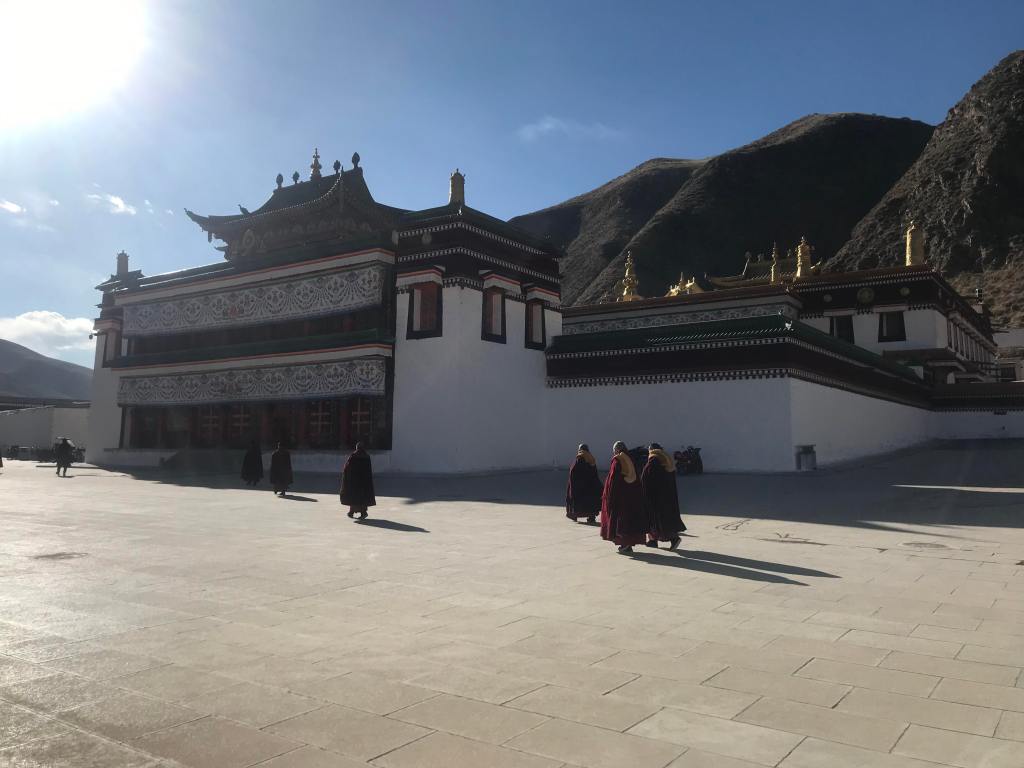
We left our bags and walked at dusk to Labrang Monastery, an enormous complex of Buddhist colleges, prayer halls, chapels, accommodation for the thousands of monks of the Gelug School of Tibetan Buddhism who have lived here for over 300 years.
Around the monastery’s perimeter scores of prayer wheels were kept spinning by pilgrims who circumambulated the monastery in the Buddhist pilgrimage known as a kora. It was mostly ethnic Tibetans doing the kora: they all looked and dressed exactly like Tibetans: bright knits, dark baggy robes, leather belts, hats, pleated ponytails, boots, old North Face jackets. The same Himalayan faces I’d noticed on the road from the airport.
Hundreds of monks walked the streets – they were mostly not on kora but on business, as it were, going into town or walking between buildings. Some were in groups, some alone, some in taxis, some in coffee shops sipping cappuccinos, some eating in Muslim restaurants, some texting on smartphones. Some smiled at me, some did not, some were old, others were teenagers: the latter group kicked footballs in the streets and carried plastic cups of bubble tea. All the monks had shaved heads and wore a thin maroon robe which exposed a bare arm.
As the sun sank below the mountains the temperatures plunged and we joined the darkening figures on the kora. Some moved rapidly, sliding their rosary beads and murmuring mantras as they heaved the great wooden prayer wheels which clicked and groaned and flashed the eight auspicious symbols of Tibetan Buddhism as they spun. One woman took two large steps and then, wearing elbow and knee pads, fell to the concrete ground in full prostration. Her forehead to the floor, arms and legs stretched out, she wore gloves with wooden blocks on the palms. She gathered herself up, took two more steps, and again fell to a full prostration.
Pledging to return to the kora in daylight we walked from the monastery into the town. Its open-fronted shops sold copper kettles and Buddha statues, knee and elbow pads for pilgrims, yak wool and yak milk. There were fruit sellers and Tibetan book shops. Beggars of all stripes were on the streets; old men with wounds, ladies who approached with cupped hands, children who held laminated pleas. On one corner was a blind man on his knees, a speaker next to him playing Om Mani Padme Hum over and over. Prostrating himself to the rhythmic mantra he would clasp his hands together whenever there was a sound of a coin or a soft paper note landing in his wooden bowl.
We entered a bright Muslim restaurant which was busy and full of steam from the open kitchen and cigarette smoke from the clientele. We ate warm eggs and tomatoes. This dish is a staple across China: fan qie chao dan – it is always good and sometimes very good. Here it was excellent, the best I’d tasted in many years of travel in China, and I said as much to the proprietor. He dismissed me with a wave and poured me more green tea.
A young couple from Qinghai Province joined our table. They both chain-smoked and were in town selling some American product, the girl showing me the product on her mobile phone. She was disappointed I did not know it. They too were ethnic Tibetans, their corner of what is now Qinghai Province part of what was the Kingdom of Tibet, just like this region of what is now Gansu Province. They were friendly, inquisitive, had an urge to visit America. Why not go? I asked. Because we are not allowed passports, they smiled.
We walked slowly back to our hotel. Streets were quiet; people were shuffling home, the shops closed early. The silence of the place was only broken when, lost trying to find our hotel, we drew alongside the monastery and heard the deep bass gurgle of chanting monks.
The kora
Early morning light made the mountainsides glow. The sun would not enlighten the valley for a good few hours. It was freezing. In the faint light scores of pilgrims were out, rotating prayer wheels, walking, chanting, disappearing into chapels, moving clockwise as a group. The monastery with its temples and stupas and learning at the centre of their great mandala.
I stood for a moment, feeling the early morning air, the height of the mountains, and the weight of the place. Then I began, by entering a small room with a giant prayer wheel at the centre, small yak butter lamps in niches in the stone wall. I knew little of what I was doing but was soon surrounded by people all moving together. There is no talk on the kora; there is no rule against it either. There are only sounds of steps, of prayer wheels, of beads, of mantras.
Slow, quick, distracted, it doesn’t matter how you walk the kora; it doesn’t seem to matter if you’re Buddhist. There are no questions. Camaraderie must come, before or after, I imagined, where tales of kora are shared, titbits of gossip on fellow pilgrims exchanged. Or perhaps not. The Tibetan laity are going for Enlightenment as ardently as the monks and in doing so they have ethical precepts to follow, particularly those of speech – ‘speaking meditation’ as one monk described it to me; saying only that which does not lead to suffering. Still, I wanted to know the pilgrims, rather than projecting onto them, hear their stories.
Instead, I began watching the symbols on the prayer wheels as I spun wheel after wheel: the white conch shell, the parasol, the victory banner, all commemorating the Enlightenment of the Buddha. Walking, rotating the wheels, following the group if unsure; that’s all there was to it. An empty white cup was suddenly thrust at me, I rejected it, thinking it was a beggar. Further on I saw a large group gathered, sitting and drinking from white cups, nibbling pastries, exchanging stories. It was a free breakfast for pilgrims; a chance to linger and speak. It was too late to turn back and accept the cup; my unskilful act of brushing it away kept me in samsara.
Monks
It was after 10am by the time the sunlight filled the valley. Thick smoke from yak dung fires hung in the air. The slight warmth was welcome and provided such brilliant light as to require sunglasses. Pilgrims continued their round, circling, murmuring, prostrating.
We took a tour of the monastery. A monk led us into the temple of Maitreya, the future Buddha. He was less interested in facts about the monastery and more in asking knotty questions: “Are you happy or not? Why? Are you a body? Why? What is your happiness? Why are some people lucky?”
He spoke good English from living in Canada, but his grin was ambiguous: I felt he hated me. But this was another projection, a cardinal tenet of Buddhism is maitri, universal friendliness, and any sort of aversion is one of the ‘mental poisons’ which keep one swirling in suffering.
When I asked him where he was from his answer was quick: From here, from Tibet! He said this watching me. He spoke no Chinese, he said. I wondered how he was allowed to go to Canada while others were not allowed passports. I was wary; I’d read in an old Lonely Planet guide that Chinese intelligence agents sometimes disguise themselves as monks, drawing in seditious tourists with stray independence comments.
A Chinese-language tour had set out at the same time as ours. The Chinese group had three ordinary-looking tourists: two girls with bored expressions and a middle-aged man in a polo shirt with a large camera. At one point, the Chinese group entered our temple. Our guide was grinning into a silence having asked “Why are humans and animals different?” I overheard the Chinese-speaking monk giving an airy summary of the temple: dates, names, a touch of history and they were gone, onto the next. During this time the monk and myself remained in silence, gazes locked.
Later, as we wandered from temple to temple, through narrow alleys between high walls and over large open squares, we were joined by a young monk. He was 16 and spoke Chinese. In his hand he carried a clicker; he explained he was here to complete 30,000 circumambulations of a temple. He was staying a few months to do this, living in a local hotel. Keen to take a break, he showed us inside the temple with its huge statues and murals of Padmasambhava, the bringer of Buddhism to Tibet, and Tsongkhapa, the founder of the Gelug School, adding details which my Chinese couldn’t comprehend.
The temple was draughty and lit by candles. At the front was a large shrine with offerings to the buddhas and bodhisattvas: fruit and money and little piles of rice. Great colourful paintings called thangkas were hung from the high rafters, the wooden columns painted in fading colour. Joss sticks burned, making the air heavy with incense smoke. A steady stream of pilgrims was viewing the temple too, clasping a wad of notes, throwing money towards an image before throwing themselves onto the floor in prostration.
The monk who’d been speaking turned to me. My partner said, would you like to give them money? They’ll chant for you if you do.
Surrounds
I refused this as it struck me as gimmicky; something for the Chinese tourists. But I questioned this decision as I drifted out of the monastery, deciding to gain some perspective by going up onto the hills to walk the outer kora.
Outside the whitewashed walls of the western end of the monastery was the Tibetan quarter, where the laity live. There were smaller local temples, a lot of concrete and low-rise buildings. Monks went about their shopping and small children played in the streets. A young boy ran past me then stopped and turned back to his companions who were giving chase, a brown face and white toothy grin. I saw a future monk, full of innocence. ‘Fuck you!’ he shouted at them in English, raising the middle figure on each hand. He sprinted off, a pack of bloodthirsty children chasing him. Monks laughed at this.
Between houses built into the rock I found a sign pointing to the outer kora, a more adventurous circuit which follows a contour on the hill. A well-trodden path snaked up and around a dry riverbed which had piles of rubbish. There were some idle yak and an enormous herd of goats watched by a shepherd who sat on the hillside holding a long stick. Up on a ridge, which was the apex of the outer kora, I too sat, taking in the expanse of Xiahe below.
There were flat roofs with stubby chimneys, some with languid smoke rising, all crowded together and connected by a warren of alleys. There was open space in the form of squares and courtyards, used for debates and dances. The monastery edge was outlined by the stream of pilgrims walking and prostrating round and round. The high peaks enclose the monastery and town and make it feel like a very remote valley; an inward-looking place which would receive news from somewhere over the hills.
It was in this way Buddhism arrived in Tibet. From northern India in the 7th century the teachings were carried up and over the Himalayas, delivered orally, and staunchly refused. Still, it was encouraged by the King; Tibet was surrounded by Buddhist states which had achieved high levels of culture: Bhutan, Nepal, Kashmir, Tang Dynasty China – the Tang Emperors oversaw a period which gave rise to art and poetry of such beauty that not even the Chinese Communists can deny it. In the coming centuries most of these states weakened their Buddhist leanings while the tradition grew stronger in Tibet until, by the 11th century, it had taken root and would never be seriously challenged. The 20th century imperialists, that is, the bristling moustaches of the British Raj followed by the ideologues of Mao, displaced it but did not weaken it.
I began my descent, scrambling down the dusty path, passing stone buildings used for solitary retreats. It was hard to know if they were occupied, but whatever worldly winds were blowing they would be havens, cave-like dwellings in which to contemplate not what was going on outside, but the mind’s response to it.
Further down I stood and watched the endless everyday wheel of the kora below, people flowing around the walls, circling several times round a traditional Tibetan stupa. I stood for a while, knowing that no matter how long I watched I would never understand.
Dance
Monks formed in a circle on a slightly raised mound of earth. Sitting on some stairs above them was an elderly lama, counting his rosary beads and watching. Off to the side, sitting cross-legged on the ground were several rows of monks. Two of them blew into 9-foot-long ceremonial horns, others bashed cymbals together, the rest were clapping their hands in a slow beat and chanting in a deep, low-pitched dirge. The monks in the circle were young, their dance was flowing; it had a ritualistic aspect. Watching one of their faces, crinkled in concentration, it seemed they were performing learned movements, following a pattern, yet there was slack; no need for them to be in-synch with each other; they performed the same movements but at their own pace. The result was bewitching; the crash of the cymbals, the hum of the horns, the deeply pulsating chants, each time it was enacted would be different, depending on mood. Perhaps designed to send performers or onlookers into a trance. Or perhaps there is a martial element: the shaven-headed young monks, well-disciplined, watched over by a lama, gave me this impression more than once. Tibetans are physically large and look tough.
A group of young Chinese appeared next to me. Compared to the Tibetans they were small and wiry. They wore clean designer clothes with cameras and mobile phones hanging from their necks. I was interested to know what they made of this, something more or less raw; not like the heavily manicured events which obsess the modern China. After watching for a few seconds, two of them raised their mobile phone cameras. They were filming the dance, panning the phone from monk to monk, watching the screen all the while until an attendant monk came over to tell them to stop, which they did, lowering their phones and standing in silence.
There was a small group of us, corralled into a small area by a gate: the Chinese, myself, and a motley of Tibetans, some of whom were down on one knee. All of us watched: the gruff sounds of the monks, dust rising as they stomped through their dance. Flowing for the sake of flow, not for the sake of performance. It evoked something deeply human; it was art of the highest form. Soon the group of Chinese turned away, on to the next attraction. And eventually I did too, hearing the blasts on the horns and chants fading as I walked away.
The next few nights the sounds and spectacle of that dance appeared in my dreams. I returned each day hoping to see it again, but the courtyard was always empty.
Ritual
In the largest hall in Labrang, high-ceilinged and stone-floored, monks wrap an extra robe around their heads and faces. They sit on cushions in rows, facing each other. A lama wearing an enormous gown and yellow hat walks between them. He voices one of the Sacred Texts, ensuring to walk among all the rows, as if sprinkling the words onto each of his disciples. The monks rock back and forth, some in deep concentration, others make jokes with companions. One smiles and waves at me. There is a great gathering of us lined up against the wall. Pilgrims throw money into the aisle; one monk uses a broom to sweep all the money into a pile. They also throw strips of paper with names to be chanted, these too are swept into a pile. Another monk-attendant carries a large jug of steaming yak milk. Each monk is only a face, sitting cross-legged in a triangle of robes. When the milk attendant approaches, a small bowl is produced from inside the robes. Steaming milk is poured in and the bowl is raised to the lips with looks of worldly satisfaction.
Leaving
We left early for the bus station. An old bus would take us to the provincial capital of Lanzhou. On the outskirts there would be glimpses of modern Xiahe: an industrial Yak dairy, high-rise accommodation, a power plant. Further away scattered stupas would give way to tall mosques, a colourful mural of Chairman Mao with smiling Tibetans and Muslims, and eventually expressways, smog and another Chinese mega city.
But in the freezing morning on the way to the bus station there was still the ever-present stream of pilgrims, the clap of wooden blocks hitting the ground in prostration, the fug of incense smoke, the horns. Another day was starting at the monastery. There was nothing remarkable about any of it. Only that I observed it for a few days; and in the process became a small part of it; and it part of me.
An edited version of this essay was published on Intrepid Times in August 2024: Pilgrims and Prayer Wheels in Xiahe – Intrepid Times
 Bardo travel: Writings on experience and place
Leave a comment