Whips at Dawn
When I leave the hotel early each morning, walking out into still air, there is the crack of a whip. He is in the corner of the large city square. Beneath a tree, in the shadows of the dusky morning he paces around a bright metal object with a whip in each hand. Each crack connects with the metal spinning top which lights up as it revolves, kept spinning by his regular whipping. He is dressed in dark clothes and has the face of one who spends his mornings with whips: long, severe. On the concrete ledge is an old transistor radio playing Chinese folk music. The few other people out at this hour give him a wide berth. The whips, the face, the bright spinning orb and tinny music emit a menace: a taunt. A challenge for a dual perhaps: whips at dawn.
There is of course more to this man than his whips. Later that morning, the light is brighter, the square is busier, and in that spot beneath the tree in the corner of the triumphant city square, he is no longer there. He has packed up his whips and moved on.
The Guizhou Dragon
When I first heard about the Guizhou Dragon several years ago, I scoffed. I was shown a picture of a fossil: clearly a dinosaur. But now, returning to the area, it was one of the first things I asked to see.
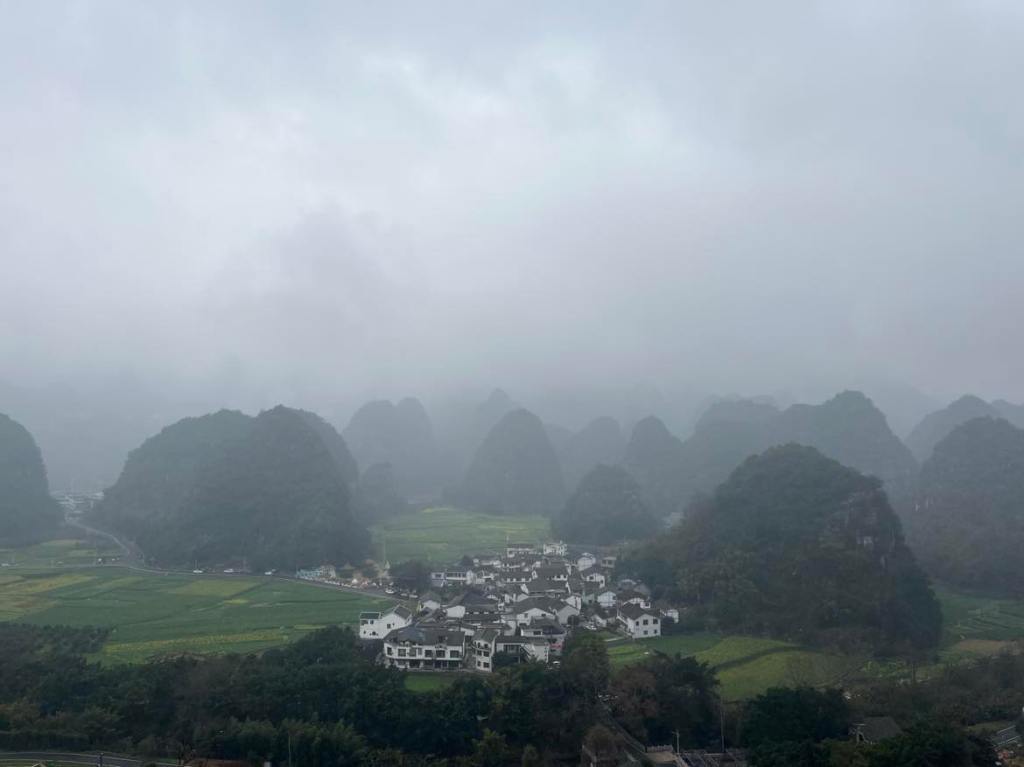
The dragon was housed in a museum outside a large city in southern Guizhou Province. The landscape was covered in countless jagged mountains. Low, steep-sided, covered in greenery, they extended as far as the eye could see. Guizhou is landlocked, but all these limestone peaks were once the bed of a warm sea. En route to the museum we stopped to look at the limestone mountain faces up close; scores of molluscs and spiral shells revealed themselves, preserved in exquisite detail. Similar conditions explained why the Guizhou Dragon had been so well preserved; laid down amid soft layers of sediment which, over the epochs and aeons, had gradually petrified.
But were we really going to see the fossil of a fire-breathing dragon? And here of all places, in the land of the dragon. In Chinese, the word for dragon and the word for dinosaur is similar. This creates a pleasant confusion; the line between one and the other is blurred. Before coming to the museum, I’d asked people whether it housed a dragon or a dinosaur. Responses were mixed. Several were uncertain; it was unclear whether the confusion was linguistic or palaeontological.
It was partly cultural: my own mythological dragon was a suspect character; living in remote caves harbouring evil intent. In Chinese myth, however, the dragon is associated not with fire but water: the bringer of monsoon rains for crops. The dragon is a benevolent force; times of drought meant the dragon had been irked – and required propitiating. Hence the festivals which galvanise the water dragon, wulong at the end of the spring festival and duanwujie just before the rainy season, both of which are still celebrated. It was later, during the Ming Dynasty, that the dragon became an imperial motif and a symbol of power, but a benevolent power, one that provides.
Inside, the museum was modern; panels in English and Chinese coolly explained the accepted geology and gave scientific names to the various fossils on display. The myth began to unravel. For a start, there was not one Guizhou Dragon but many. Long, skeletal forms of the same species lined the walls and rooms. Varied in size, all had long snouts and polished bones. Only the flesh was missing, along with the scaly clothes they once wore. Apart from this they were so well preserved they looked as if they might have perished only last year. But they died 300 million years ago, another information panel said.
Despite appearances they were not dinosaurs. A dinosaur is terrestrial, a panel explained, and these specimens lived in the sea. This does not make them dragons. Instead, the panel went on, they are marine reptiles.
The museum was the antithesis of myth: with its neat classifications and its laboratory behind glass with white-coated staff peering into microscopes. The gift shop sold fluffy marine reptiles and children ran around clutching half-finished Fact Sheets. What happened 300 million years ago was known with a dull certainty. There was nothing to learn. Only lists of names to remember and myths to forget.
Before leaving I stared at the largest marine reptile by the entrance. I couldn’t decide which belief I’d rather have: that we understood everything about it or that it was a water sprite who lived behind the clouds.
Mountain Tourism
On flatland between the sheer peaks are rows of bright green vegetables. Judging by the abundance of grasses, vegetables and herbs the soil here is fertile. Every bit of land is neatly cultivated. But growing quicker than any of the crops is tourism. A dark tarmac road snakes through the landscape. Cars prowl along with windows down, mobile phone cameras dangling out. Some stop the car, get out and enter the rape seed fields for a photograph. In the background are the brooding limestone karst peaks.
Wang Feng Lin offers – according to its pamphlets and billboards and posters – Mountain Tourism. The main village road is crowded with street food, restaurants, stalls selling balloons, sweets and ice-creams. The smell of meat and chilli oil hangs thick in the air. There are fairground rides playing loud music. Outside souvenir and clothes shops, loudspeakers play the same 10-second jingle on repeat, creating an incomprehensible cacophony. Swarms of people move along this street; locals from Guizhou Province but some from further afield. All are here to engage in Mountain Tourism. As you purchase a balloon, or bite into a sausage on a stick, or as you dab your lamb shank in chilli oil, or watch Tik-Tok videos on your phone, the mountains bear witness; they are with you. For the intrepid, electric golf buggies whisk you up a private road on the side of one of the mountains, stopping at regular intervals for you to pour off the buggy with the rest of the passengers. You may all take the same photo, then get back on.
Before entering the Tourist Area proper, we sat in an eatery to eat dan chao fan – egg fried rice – which is the local dish. The family at the next table stared at me. There were three generations – the grandfather perhaps in his 80s, a small child barely 10 and the child’s father. After a minute or so one of them said ‘lao wei’! ‘foreigner!’ It was difficult to know which one said it. It prompted laughs. The word was repeated. As they dipped their chopsticks into the various plates on their table, their gazes remained fixed on me. I said Ni hao! Which brought more laughter and shaking of heads. They resumed picking at their plates and staring at me as if I was a television.
I was glad to leave the restaurant. We rented a pedal kart which was shaped like a cartoon squirrel and pedalled it into the Tourist Area. After struggling up a hill we took a side road which was quieter, parked the kart and walked among the fields.
I watched a man squatted on the ground working with a sickle. He used the tool to slice at roots, placing the cut grass in a pile. Behind him were the steep walls of the mountains. A white cigarette behind his ear was bright against the dark skin of his face. I watched him swish away for some time. He was undistracted and focused on his task but for one moment when he stood, hacked up a tremendous amount of phlegm, and released it into the field. After he this he squatted back down to resume work.
We walked further along the road. There were small shacks and some newer buildings. A small woman padded past us wearing plimsoles and an old anorak. She did not make eye contact. She had an old face pulled taut by age and sun and soil. A man struggled past us with an enormous rattan basket on his back. It was full of the morning’s pickings: grasses and vegetables. His face too was almost one with this land, flashing some goofy black teeth at us.
It was unclear whether these people were stooges of Mountain Tourism or decaying remnants of old China. I hoped they were the latter, the last generation not to own smartphones and live in tower blocks, quietly working the land, unpulled by cheap notions of a better life in the city.
 Bardo travel: Writings on experience and place
Leave a comment