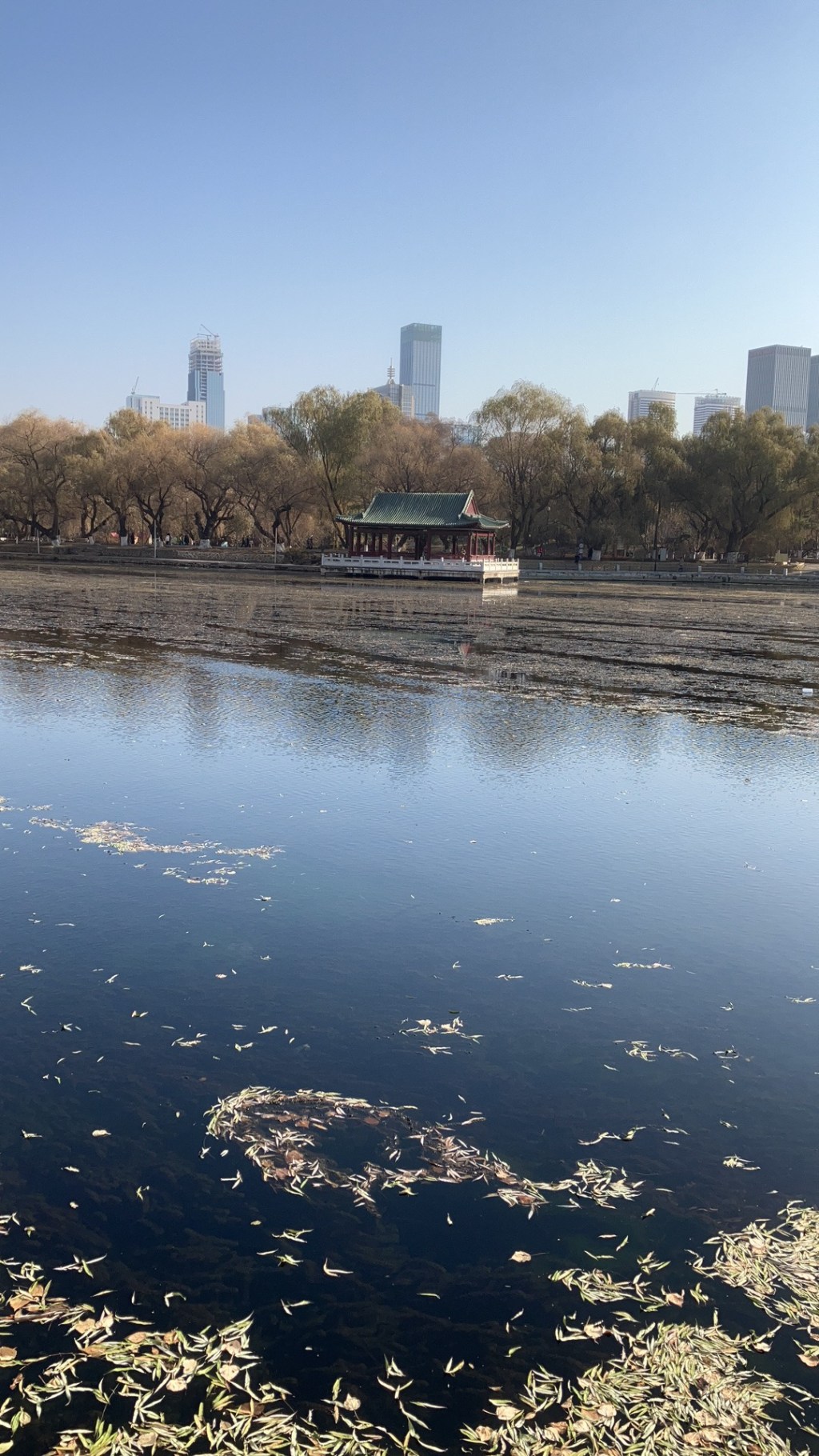
…Or is it a river? It sits amid a huge city park near my apartment. The body of water bordered by concrete walkways; the water clear, shallow. There are dark plants on the bed. They lean in the direction of a flow which is not obvious on the surface. I turn to walk in this direction of this flow.
The lake-river is in a large city park in Shenyang, a city in the northeast of China. Just like every day since I arrived here there is a winter sun. This means freezing temperatures and beautiful light; psychedelic sunrises and sunsets, temperatures hover around zero during the day and plunge below that at night. And the night arrives around 4pm each day. The sky as black at night as it is blue in the day. Stars and the moon’s phase are so large over the city they are impossible to ignore.
It is Sunday morning in the park as I walk by the water. The local people are at leisure. Many elderly people in woollen hats and great thick coats, some middle-aged couples with children, an occasional university student eating a sausage on a stick or an ice-cream cone. When I reach a small concrete square I sit on a bench to watch a man doing tai-chi. Siberian gusts blow dry leaves which swirl and scratch along the paving slabs around the man’s tai-chi slippers. Dressed in a baggy blue felt tracksuit, his movements are slow and graceful. He is aware of my sitting watching him but makes no obvious sign of feeling observed. I know nothing about tai-chi but sense he is a master. This is a city park. In the distance are barks and growls from traffic, the air frequently vibrates from the international airport. But there is a soft beauty to this man’s tai-chi in the park. Watching him is like watching the water bending the plants.
My sitting alone attracts attention. A man in a Russian-style deerstalker hat approaches me. He works in the park, he says nodding to a wheelbarrow with a rubbish bag and a broom. He is smiling as he asks me questions. His teeth are short straight butts and are dark as soot. He asks me where I am from. When he picks up on my Chinese he sits down next to me on the stone bench and offers me a cigarette. His second question is how much is my salary? His third is how big is my house? His fourth is why don’t I answer such questions? Here my Chinese ability fails me. We are reduced to gesturing, showing our toothy smiles. He takes a long draw on his cigarette.
Our conversation attracts others. Where is he from? a passing woman asks the man. When I offer a response this is enough for friendship. She produces her phone and asks for my WeChat contact. In this way we can learn from each other, she says. I give her my details. She walks away. Later she tells me she is staying in the nearby hospital for 15 days and I do not know how to respond.
As the woman leaves, scrutinising my profile picture on her phone, another man on a bicycle joins us. It is an old-style bicycle, the sort that everyone used to ride in Beijing before cars. He wears a surgical mask loosely around his chin and a shoulder bag. He is 67 he says – how old am I? We enjoy a long, broken conversation. He has never been far outside of Shenyang, he says. His sons are tall and work as painter-decorators. He takes out from his bag a ping-pong paddle. Handing it to me I feel its smooth, worn handle and surface, reading aloud the name of the German brand. He has two ping pong balls which he bounces on the cold concrete. Who does he play with? Whoever is around. If only, he laments, I had my own ping-pong paddle we would go and have a game now. When I say I’m off, he arranges himself on his bicycle. He leaves me with the sage advice that to improve my Mandarin I should listen to people more. I walk away, the man in the square still silently doing his tai-chi.
Further along the walkway by the water is a street with people selling antiques. They are lined up on both sides of the pavement. On the ground they have laid out cloths with all manner of things for sale. Old books, cassettes, CDs, videos, some pornos, old watches, cameras, Mao badges, knives, new clothes and boots, old hairdryers, statues of Buddha, jewellery. It seems illicit. The rectangular cloths designed to be bundled up quickly should a quick escape be needed. But further down the pavement are the Police. Pretending to be interested in a Mao Zedong book I watch an officer approach a vendor. He picks up a watch, ask its price, then puts it down and moves on.
The pavement vendors are just an appetiser for the main event. At the end of the street is a large purpose-built antiques market. Only open at weekends a sign says. Inside are scores of stalls. Like any antiques market there is a huge range of goods, from the exquisite looking Chinese scroll and porcelain to worn plimsoles and rusted canteens. It is like walking through all the past iterations of China: auspicious bracelets and charms, elegant vases and scrolls, old money and books, military hardware, Maoist merchandise, then counterfeit handbags, video games, old cigarette packets and bottles of rice spirit.
There is animated haggling. All the vendors are polite, not pushy. They allow us to linger, pick things up, respond courteously to requests for prices but put no pressure on anyone to buy. It is as if this Sunday morning the antiques are just an excuse to come and be among others, the selling and buying is beside the point.
I leave the market. Outside the main entrance a man sits by a cart which is a coal oven in which he heats sweet potatoes and sells them for 15p each. This creates a pleasant smell and, after buying one, keeps my hands warm as I cross a bridge and return by the water on the other side.
Here people have set up speakers and are singing into microphones. This is very loud. As I approach a man singing he offers me the microphone. I decline, saying it is much more pleasant listening to him. He is 70, he says, and this is his ai hao, his hobby; singing alone by the river. I marvel at the self-confidence needed for such a hobby.
Nearby, old men dangle fishing poles into the water, which here seems even more languid. The chance of hooking a fish seems remote. But one man’s line tenses. A passer-by stops to watch. The fisherman begins to reel, his excited pulling creating more tension in the line. More people gather, hands clasped behind backs, to watch as the glistening line is reeled in. Finally, its hook emerges. It is a leaf. The man slows his reeling, winds his rod in, unhooks the leaf, and casts the line back into the water with us all silently watching.
I cross a busy road where a group of men are standing on a corner. Signs advertise they are available for all types of work. Their signs advertise their skills: locksmiths, metal workers, drain unblockers, heavy lifters. Most are wrapped in big jackets and hoods against the cold. Their brown or red faces like Inuit. Some smile at me, one shouts ‘xin fu!’ ‘happy!’ Which is the city’s slogan ‘Xin fu Shenyang’ which has a nice alliteration when said in Chinese and seems, in my mind, associated with the constant sun, lighting faces and moods. I return the greeting. Around the workers is a pop-up economy: a woman serves soup from a large urn. A market vendor has strayed down here to sell large boots and jeans. A barber in a cloak has set up a single chair and has a customer. Out here in the freezing sunny air, his salon is in his gloved hand: a comb, scissors. Good morning, he says smilingly as I pass.
After I cross the busy road I am back in the park. There is an area in which laminated A4 pieces of paper are hung up like sheets. They sway in the gentle breeze. On each laminated paper is information about a single person. Their age, weight, height, salary, education level, hobbies. Sometimes there is a picture. Always there is a contact number or WeChat name. This is a singles fair. Most of the adverts are females. People, who look like parents and are mostly women, busily move among the adverts, jotting down numbers, exchanging thoughts with others. Some men move around too. Their mobiles out, scanning QR codes or inputting numbers, sending opening gambits out into the ether.
From here I return to my flat which is on the edge of the park. The previous day I found a farmer’s market and bought some tomatoes, cucumber, kimchi and tofu. None of this requires cooking so I wash the veggies, chop them up and mix them together in a bowl. I eat this sitting in my south-facing window, enjoying the warmth of the Shenyang sun and savouring the local flavours.
 Bardo travel: Writings on experience and place
Leave a comment