According to the British Pilgrimage Trust, any walk becomes a pilgrimage if the walker sets an intention. An intention could mean asking for help, expressing gratitude, or thinking through a problem. Travelling on foot with not only geographical and physical goals but also personal ones resonated with me.
On setting out on the St Cuthbert’s Way, I chose two questions. They were:
What should I move towards in my life?
How can I make more friends?
Questions wide in scope and ones I had chewed over many times, but I liked the idea of posing them, walking, then listening for answers.
And before I knew it, before I’d properly begun, the walk was providing them. I made my way to Melrose Abbey, the start of the St Cuthbert’s Way, by train. Edinburgh tenements disappeared and the pudding hills of the Borders grew. At the end of the line at Tweedbank, a wet Thursday in January, few others got off. Certainly no other pilgrims. It was as if I was the only one here for this.
I was staying overnight to start early the next morning. My host was Charlotte. New to Airbnb, she had walked the St Cuthbert’s Way last summer. The air in her two-bedroom flat was thick with incense smoke and cats. She had three who were not allowed out. She had turned her small living room into a cinema. ‘Shawshank Redemption starts at 9 if you want,’ she said. I refused, saying I had things to do.
That night I lay awake on the camp bed in her spare room, listening to scratching in the litter tray, batting of the food dispenser, sudden dashes into my room, waking to see little snouts in my bag, my movement making them dart back out.
In the early morning I heard more cat noises, padding in the hall, illuminating the motion-sensing lights. Only the firmer steps – then the flush of the loo and click of the kettle – confirmed it was Charlotte. I lay awake awhile, unsure. Obsessed with my morning routine, I wanted to go to the toilet, do my stretches, then make a strong coffee to drink in my room with my book. When I crept along the hall she was there, with tea, offering me coffee. She sprinkled a half teaspoon of coffee granules into a large mug, filled it with boiling water and handed me the result. I stood sipping for half an hour while she showed me pictures of her walk.
When I was ready she drove me to Melrose, telling me about the town being the home of rugby and Doddie Weir, and more about her own journey, saying she’d like to walk other routes but had nobody to do them with, then saying if I needed a lift along the way, just text.
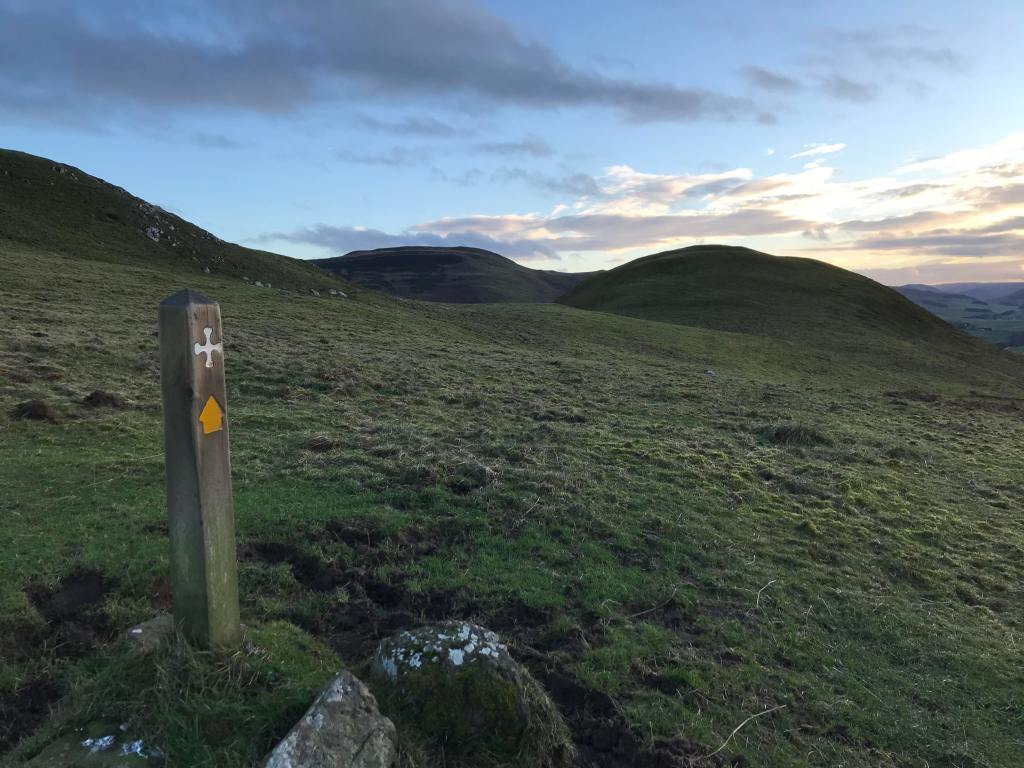
I got out at the Abbey. The start of the Way is without ceremony. Subtle way markers point you out of the town and up into the Eildon Hills. Soon you’re on the saddle between these three mounts, which the Romans called tri-montes or Trimontium, looking down onto their former fort of that name. I only knew it was there because I had read it. The fort has receded into the earth, it is an indistinct presence. Not just the fort; everything looks insignificant from up here. Only the route’s way markers, a medallion and an arrow on posts, often hidden in heather, seem important. As I continue up and over the hills, I watch them to learn their mood: their frequency; their ambiguity when the path forks. They will be my guide over the next four days. There is an immense purpose in moving through the landscape like this, guided by these symbols, pointed by arrows, being reassured the path you are on is the right one.
The trail on the other side of the Eildons ambles by the River Tweed then sweeps up a hill to a dry stane dyke which, when you cross it, becomes a dry stone wall: the wall marks the line between the Scottish Borders and the English border. Soon I saw a St George’s flag hanging limp in the January air. Signs displaying access laws became starkly different.
Before climbing to this border wall, I spoke to a man walking his dog at the foot of the hill. We spoke of the large moon which was out, and how some say it influences our moods. ‘Aye well it disnae affect me, but!’ he said, ‘the wife’s a different story, mind!’ He said she was in church. ‘This is ma church!’ he said, gesturing up the hill he’d come from and where I was going. Later that day a woman on horse back called out to me ‘Alreet pet! I wiz walking yesterday, like, but today on me horse!’ Pure Geordie. Where this accentual shift took place I can only say in walking terms: half-hour on the Scottish side and about three hours’ travel, due east, onto English soil. Changes in language, in law, are felt keenly when on foot.
So too is place. An embodied sense of place is among my strongest impressions of the walk. On arrival in Wooler on the English side of the border, I planned to catch a bus to my Airbnb in Lowick, a village 8 miles away. It was a late Sunday afternoon, dusk, when I staggered off the hills into the small town. When I asked a man the location of the bus station he laughed incredulously, and when I said I was hoping to catch a bus to Lowick he almost collapsed in a fit of mirth. He was wrong: the Wooler Bus Station with its three neat stances was just round the corner. But he was also right: each stance’s timetable said No Sunday Services.
I was soon striding out, a headtorch strapped to my head, along a B-road towards Lowick. I had walked 16 miles already so this additional, and unexpected, 8 miles held the potential to be tough. I followed the road signs, checking off the half- and quarter-mile distances to Lowick, moving steadily, and increasingly wearily. At about half-way I sank onto the ground by a gate and ate what I had in my rucksack: half a bag of salad leaves, some water melon. A few cars flashed by. I had been walking hurriedly, at first gently chastising myself: I had missed the bus through poor planning; the road had no pavement. I had to jump onto the verge when I heard a car. It would slow, its full-beam headlights illuminating a hooded figure with a stick, then speed up again. But it was not a busy road. Most of the time I clicked off my head-torch. The night was still and clear. The moon the man had spoken of was bright. I saw a brilliant comet. Stopped to rest at that gate, pausing for a moment, I heard a great range of sounds: an owl hooting, the rustling of a pheasant, something chewing, some heavy nasal breathing. I shone my headlamp into a field and a million glinting eyes were illuminated back at me. What exactly was I hurrying to? To escape the view of a moon bow as it emerged from cloud? My exertion had warmed me up, I was glowing in the night.
When I arrived in Lowick I had been meditating on the place name for several hours through a dark, magical night. Lowick held for me a key: it was in a lockbox with a combination dial which my hands were too frozen to open. I called the landlady who appeared in slippers and pyjamas, opened the lockbox quickly, and returned to her living room. I stepped into the converted shepherd’s hut, my lodgings for the night. After a warm shower I sat with my legs up, socks off, drank a beer, still feeling the glow, my bare feet pulsating.
The next day I returned to Wooler (by bus) to continue. It was a day of 15 miles to a place called Fenwick. Up onto high moorland, through forest, over low hills. From the top of one I caught a glimpse of the end: Lindisfarne, the Holy Island, stretched out as if protecting a sea inlet. A castle on a pinnacle at its tip, a small village huddled on the landward side on what must be terra firma. The rest of the isle looked like sand dunes, tides, part of the sea.
The island can only be accessed at low tide via a causeway. I was moving closer to this all day. But in my mind was Fenwick. When I reached that village I was surprised to see a community meeting would take place, a sign advised, in Lowick. Odd, I thought, Lowick lies a good day’s travel away. Further down on the main road a sign brought me to my senses: the distance by road to Lowick was 2 miles. Close by was the busy A1, a quiet sign pointed off it to Lowick & Fenwick. It explained my landlady’s dull response when I said I’d come from Wooler: by bus the journey took 14 minutes; on foot it was an adventure. To spend all day moving towards a place, tramping towards a name, is to have it indelibly marked on you. You see its name and feel the ground, its hinterland, the effort it takes to get there. I had to wait to cross the A1. Cars and lorries sped past the insignificant sign to Lowick & Fenwick, I caught flashes of drivers slouched with dull expressions. I crossed eventually, now not far from the causeway to Lindisfarne.
This was my fourth day of walking. I had the feeling we get when we train hard, or go for a long bike ride, or after a period of healthy living. There is focus, purpose. There is no excess energy left for worry. Only the effort needed to follow the arrows, to fuel the movement, to rest enough to keep going. At the bookends of each day a shower is godly, a duvet divine. And food! drink! Life is exquisitely simple.
When I arrived at the Lindisfarne causeway it was covered by a dark sea. I set off and found an inn to wait for the tide to drop. When I returned, there was the road, revealed, inky black, wet, sandy, confirmed as viable as I watched a vehicle’s lights cross over. I followed, sauntering the final 5 miles to what I knew would be a warm bed, aware this was the end.
There would be no revelation, I told myself. My questions were as lingering as they had been before the walk. But when I arrived, nestling into an ecstasy of comfort, reflecting on my days of walking I saw answers there. Lots of answers. Answers were everywhere. It was the questions I needed now.
 Bardo travel: Writings on experience and place
Leave a comment