‘In Shaoshan have just 7 taxis’ the driver said in a melodious Hunanese dialect.
A bullet train had whisked us here from Guiyang, a city 800 km away. Through the windows en route were flashes of green mountains, towns on rivers, the train racing through scores of long tunnels, crossing countless bridges. In our carriage an electronic display showed the train’s speed (250km/h), the inside and outside air temperatures (23 C & 38 C, respectively) and sometimes flashed in red lettering: having departed from Chengdu another 800 km away, the train was running 2 minutes’ late. We’d alighted at the gleaming Shaoshan high-speed rail station, similar to all the other rail stations across China. The usual crowd of people poured off the train, pushing small, wheeled cases, lighting cigarettes, texting out their arrival. Only when we stepped outside into searing heat was there an inkling this was not another identikit Chinese city. Rather than the usual swarm of taxis, there were none.
‘Just 7!’ the driver confirmed.
We’d stood for some time on a quiet road outside the station when this battered cab had come down the road. I sat back as the driver explained why there were just 7, not understanding his words but enjoying their rhythm, imagining the reasons for myself. Perhaps taxis were frowned upon here; overly feudal, too capitalist for the place where Mao Zedong was born. I liked this idea. In a country fixated by the future and development and being modern, maybe here was an enclave of preservation.
The strangeness of visiting Shaoshan had appealed to me. Since his death in 1976 the idea of Mao Zedong has been in flux. All over China he is visible: his pumpkin face on every bank note, his portrait on the wall of Tiananmen Square near where his embalmed corpse lies, often with a line of weeping mourners. Many towns and cities still have a statue of the waving Chairman. I’d always assumed that within the country he was venerated, at least in public. Once I’d even clumsily compared him to William Wallace. But listening to people in China, his reputation is far more ambiguous, like Wallace there is a mist between where the man ends and the myth begins.
My notion of Shaoshan being a communist enclave was quickly corrected as we checked-in to our hotel. The lobby with its Bond-villain bling; towering black marble columns, chandeliers, long leather sofas; bellboys wearing fezzes and name badges in English who insisted on carrying our dusty bags. The lack of taxis was more mundane-capitalist too, my partner Lingyi explained. She’d been listening to the driver who’d said a taxi licence was expensive and most visitors came on organised tours so had no need for a taxi.
Apart from the lack of traffic and resultant quiet, the view of Shaoshan city from our air-conditioned hotel room on the 18th floor could have been any city in China: long, straight three-lane boulevards, high tower blocks, construction sites, the flat city surrounded by mountains. What was different was that this place was one of pilgrimage; seen by some as the birthplace for the gleaming, efficient, hyper modernity that is today’s modern China.
When Mao was alive his supporters came here on foot, allegedly beating drums, singing marching songs like The East is Red and overnighting in peasants’ homes along the way. Most stopped coming after Mao died. Shaoshan fell into obscurity through the 1980s and 90s, occupying an uncertain position as everywhere around it started pulsating with born-again capitalism. Under Mao’s successor, Deng Xiaopeng, China ‘reformed and opened up’. Pilgrims turned away from rural places like Shaoshan and instead marched towards the bright lights of the fast-growing cities.
Part of Shaoshan’s strange appeal for me had been reading the accounts of visitors as this great change was occurring. When Paul Theroux and Colin Thubron visited (separately) during their train journeys through China in the late 1980s, both made it sound appealing; a difficult to access backwater. A historical place with little external commentary where one could wander, trying to imagine what the place may have been like at the turn of the 20th century when Mao was a boy here. But now things have changed: the pilgrims have returned.
We arrived the following morning at the Tourist Transfer Centre; a stadium-like complex of auditoriums, car parks and the main building which was emblazoned with a large red star. Inside was a cavernous bus station. There were fifteen stances and one destination: Shaoshan village. This lies about 5km from the much newer city where our hotel and the train station were located. We purchased tickets and joined others moving past the souvenir shops then zig-zagging between fences designed to manage large crowds.
By Chinese standards it was quiet. Most of our fellow visitors were here as part of their duty: groups of workers, government officials, large parties of school children. Many carried China flags and wore badges with a picture of Mao. These were easy to obtain. Everywhere was Mao. Shops and stalls sold models in all sizes, from small dashboard-sized busts to almost life-sized statues; always wearing a Mao suit, painted head to toe in gold, with a red cotton neckerchief. Alongside the models every shop stocked bottles, t-shirts, badges, statues all emblazoned with his face and often a quote: Serve the People / Political Power Comes Through the Barrel of a Gun. On the t-shirts and bags there were different flavours of Mao: there was young Mao wearing a cap and a revolutionary glint, operational Mao pointing commands, but by far the most common Mao was the face of all the statues: benign, looking calmly into the distance, a grandfatherly figure, unlike any photographs of him I had seen.
The bus journey to the village was along a road with no pavement. Today’s pilgrims are discouraged from walking. We passed fields with farmers hacking at the ground then turned up a valley road to Shaoshan village. The village was unconnected by road or river when Mao was born here in 1893. In the thick foliage were tigers and leopards. We alighted into a large building with marble floors and escalators. The building served no obvious purpose. Once outside into the heat, there were sign posts and streets, a bank, a hotel, shops, people in sombreros selling water and melons, countless souvenir shops, and only cicadas, mosquitos and the odd snake in the dense but heavily manicured greenery.
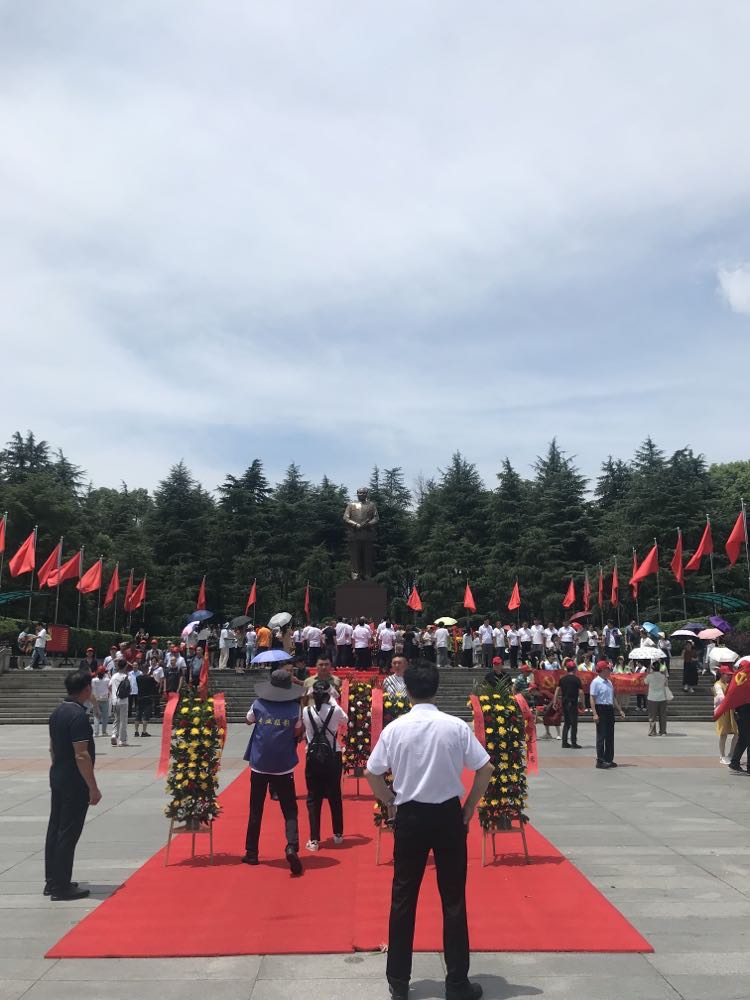
Our fellow passengers moved in the direction of the main attraction, and one of the few genuine historical places of the village, the farmhouse where Mao was born. We drifted the other way, coming to a large concrete plaza. This was Mao Zedong Square, created in the mid-1990s, its focal point a large bronze statue wearing what was becoming a familiar sight; Mao’s benign smile.
The base of the statue was surrounded by colourful wreaths and bouquets: there were large crowds. Some people were on their knees, silently praying before the statue, others lit sticks of incense. There were groups of workers and students unfurling banners – Red Education Visit from Yufeng Farmers Association / Chongqing West Young Pioneers Patriotic Visit June 2023 – all posing for photographs. A formation of soldiers from the People’s Liberation Army marched towards the statue, parting the people. They came to a halt, observed a minutes’ silence, ceremoniously placed a wreath, then marched back to their living quarters in the village. A group of government officials in their short-sleeved white shirts and black trousers were lined up, chanting a pledge. There was a constant stream of offerings, prayers and thousands of cameras trained on the smooth bronze face of Mao who stared down the long flat square. It was a vast, a mini-Tiananmen, designed both to awe and accommodate crowds. A hotel employee, almost giddy, had shown us a video on her phone of how busy the place gets during national holidays.
Sitting in the shade watching this I became fascinated. From a bird’s-eye view the square may be cruciform in shape; certainly all the devotional acts carried a religious fervour.
We retreated from the heat into the museum with its air-conditioning. This was more hagiography than biography. At the entrance Mao is hewn from white marble, solid as the rock he sits on, holding a piece of paper which nobody was able to explain. In the museum, his years in Shaoshan and the nearby provincial capital Changsha are poured over: helping his classmates with homework, becoming obsessed with books, receiving a good education. The museum was busy, but there seemed to be little interest in the information panels or old pens and clothes of Mao. People go on pilgrimage for many reasons; often more personal or social than ideological or religious. The Marxist foundations of a former leader were not as interesting as a big-nosed foreigner. Young Hunanese schoolchildren came to me, one, two, then a group of four. Soon I was flooded. They all wanted the same thing: a selfie. Some stared at me for some time, the same way I stared at the sepia pictures of Mao in his various guises, projecting. ‘Are you from Xinjiang Province?’ one of the students asked me. Another gave me his bracelet before they were summoned to their bus.
The museum had a big build-up to 1949, when Mao proclaimed the People’s Republic. The exhibits after this were brief. The events of the Cultural Revolution, two panels explained, were ‘wrongly executed’ and led to a decade of ‘catastrophe’. I scribbled these words down in my notebook as party cadres flitted around me. This same room is dominated by a space capsule, which Mao was apparently interested in, evidenced by a picture of him smiling in a physics laboratory.
Back into the heavy air we made our way to the house, moving slowly. It wasn’t just the heat making the air heavy. Shaoshan reminded me of other places where politicians are worshipped: Franco bars in Spain, a Pinochet enclave in Chile, places where devotion is assumed; debate or nuance is not present; a vague threat of violence in the air.
Outside Mao’s natal farmhouse a skinny PLA soldier was standing to attention, his eyes flitting left and right. It was a large house with stucco walls and black beams. Mao’s father was well-to-do, his mother an ardent Buddhist. The house had been destroyed by Mao’s rivals but rebuilt after 1949 when the Communist Party took power. It sits in a pretty valley with steep forested slopes, lily ponds and paddy fields. Like everything in China it looked new. There was a large gathering of people as we approached. The house itself was cordoned off with a rope. The house had closed at 4pm.
Mildly despondent at missing the main attraction, we drifted up a path following a sign post to the Mao family tombs. Here was a steep set of stairs up through the forest with old ladies selling flowers. One thrust me a withering bunch wrapped in crinkled plastic and looked at me pleadingly. For a moment I thought she was a devotee, selflessly handing out flowers the way the Red Cross often wait for injured pilgrims. But she quickly named the price ‘18 kuai’ (about £2). I paid and on we ascended, passing other flower vendors, the corners of their mouths rising to smiles as we passed various tombs of the Mao clan, me gripping the flowers, which had almost certainly been used for purposes ceremonial before. Soon we were at the top of the hill, where Mao’s parents rest. Two headstones face an auspiciously good direction. It was here that Mao, by then Chairman Mao, had come to Shaoshan for the last time, to pay homage to his parents on this little hill in Hunan.
By the tombs a security guard was fanning himself with his cap, several other flower vendors had followed us up and were watching with their hands behind their backs. Laying flowers on Chairman Mao’s parents’ tomb had not been on my China itinerary. But unable to undo the situation I found myself placing them quickly, trying to be both respectful and ceremonial, then quickly descended back down the path. ‘You did a good patriotic duty’ Lingyi said. It was by now 5pm, the flower vendors were packing up, disappearing down forest trails. Back to their little shacks; they were peasants, their lives not so different to the turn of the 20th century which fired the start of a revolution.
‘No’ Lingyi said. ‘They are not starving now. They have electricity. Their lives are better.’
We returned back the way we’d come, past the still-closed house, through Mao Zedong Square, still full of people worshipping at the statue. Irked to have missed the main sight, I thought to return the following morning. But then I reconsidered. Not entering allowed for the unknown. Inside, everything was likely manicured, unreal. Not going in, on the other hand, would allow room for the imagination, for some myth – which is usually more interesting.
And this is why Shaoshan was fascinating to me. Every nation has, and needs, its story, its heroes and villains, helping to define a national identity. What was fascinating in Shaoshan was watching this being constructed in real time.
 Bardo travel: Writings on experience and place
Leave a comment