Did they build this tower block to withstand such a storm? Brilliant flashes lit up the night sky and thunder shook the room’s windows. On the way from the airport, we had passed building sites on which similar towers were being erected. Women and men with weathered skin in wide-brimmed hats were pushing wheelbarrows, cigarettes at the corners of mouths, a 1980s transistor radio perched on a rusty cement mixer. Another series of flashes lit my face. The furniture in my apartment was still wrapped in plastic and the place had a powerful smell of paint. It felt that this was the building’s first proper test against the elements. Lying on a mattress as hard as stone, the question prevented sleep.
*
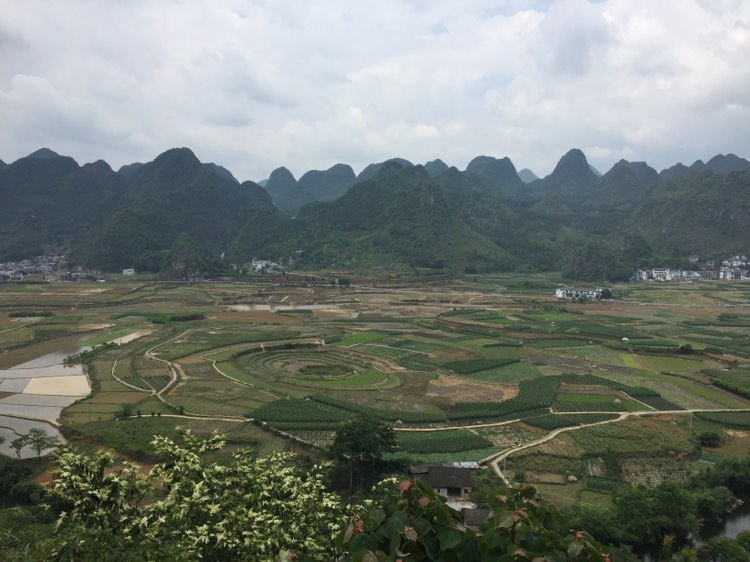
A few days earlier I had been sitting with a new colleague called Hazel in a university’s seminar room in Scotland, being briefed on the 3-month English-language programme we were to teach. Two course books thudded onto the table. The next day we were on a flight to Beijing then another into deep China. Stepping out of the airport, mountains dominated. Scores of them; small, jagged, green, disappearing into the haze. Hazel tutted. She’d been here the previous year and lamented the fast-developing city in the foreground: straight lines of grey concrete, a Meccano of cranes, tower blocks thrust up like shoots, many with neon Chinese characters flashing something incomprehensible.
A student who spoke English had been sent to meet us and we all squeezed into the back of a taxi. The student said to call him Bill. He wore a silver watch which slid down his bony wrist when he tapped his smartphone – which was often. He did this to answer all our questions – of food, accommodation, schedules – and as a thin cloud of smoke from the driver’s cigarette settled around the roof of the car, we too settled into silence. The taxi drifted between lanes on a quiet, new motorway which cut between the countless mountains, sometimes passing a clearing with an army of peasants putting up a new building. ‘Karst’ Bill said, seeing us looking at the extraordinary mountainscape. Gazing at them himself, Bill said he was from a town in the hinterland that we wouldn’t know. He was studying business and hoped to work in one of China’s most developed cities which he voiced like a mantra: ‘Beijing, Shanghai, Guangzhou, Shenzhen.’
The taxi deposited us on a university campus, at what Bill told us was a ‘teachers’ building’. He showed us up to our apartments on the 20th floor and then fled; back to his student dormitory, just as the first rumbles of thunder sounded.
*
The building held firm that night. When we stepped out into the morning humidity, the only evidence of the storm was the wet paving slabs. Hazel and I made our way across campus to an administration building, a greater distance than we’d imagined. A dozen mountains had been dynamited to make room for the vast campus. The teachers’ buildings, student dormitories, sports facilities, canteens, coffee shops, post office, classrooms, libraries and administration centres were linked by a scheduled bus service and a network of paths. There was a hospital and up on a hillside there was a cemetery. ‘It’s right’, people nodded to me later, ‘you never need to leave.’
Hazel was upset. As we walked, her pretty eyes filled with water. She bemoaned the long flight, the hard mattress, the squatty potty, the storm that had kept her awake. Something en route had rumbled her stomach. We were teachers; officially we were going to meet our educational partners to be briefed on our upcoming classes. But Hazel was clear: first, we were going to complain.
Lynne nodded as she noted down Hazel’s concerns. The three of us sat around one corner of a long table in a meeting room which looked like it had never been used. Lynne was scribbling Hazel’s demands on a piece of paper torn from a notebook: mattress, black-out curtains, ear muffs. On the walls, framed paintings with calligraphy looked like the mountains: as if they held secrets to unlock.
And Lynne seemed to hold the key. She was our fixer, an English-speaking administrator tasked with dealing with foreign friends: tolerating complaints, telling us where to be and doing our admin. ‘You and Hazel have the same birthday,’ she told me, handing back my passport.
We had little else in common. Hazel was unsatisfied with the replacement mattress, never settled into a regular sleeping pattern and began counting down the days until she could go home.
One way to escape Hazel was to go swimming. I had brought my trunks when told the campus had a pool. On my first visit two ladies were asleep on the reception counter. When I cleared my throat one woke up and began shouting, which woke the other. I left feeing confused but returned later that week, this time with Lynne. A similar scene played out. Lynne explained the bleary-eyed shouts were merely asking me if I was staff, student or public, and whether I was carrying a bathing costume. When I joked I was not, that in Scotland we always went without, the po-faced receptionists produced a box of costumes, but Lynne smiled a quiet smile.
After this we began taking walks together. Me leading her to the tops of the little mountains at sunset, bottles of beer clinking in my backpack, or to the top of our teachers’ building, where she also lived, to look over the edge or up at the stars. Sometimes she’d come swimming with me. I prodded her with constant questions about China. Lynne was Lingyi and, for me at that time, embodied everything Chinese: gentle, easy-going, mysterious. She laughed when I joined the groups of older ladies who were square dancing and took pictures on her phone when I stood with monkeys at a local temple. ‘Look like you’ she said; one of her habits, which I adored, was a tendency to drop the subject of sentences.
She invited me to her hometown for an upcoming holiday weekend. She was from further south, close to the border with Vietnam. Even after an hour’s flight the tiny, jagged mountains were still there, fortifying my impression of a different world, one of strange forms, heavenly energy and mysterious people. In fact, the mountains had become even more numerous; the region was less developed. Lingyi’s cousin picked us up from a quiet airport and drove us an hour into the countryside, to a B&B run by a young couple who’d relocated from Shanghai.
It was on this trip that two seemingly random happenings formed my impression of China. An impression which would go on to change my life. The first was when Lingyi’s cousin Yao picked us up in a large, air-conditioned car. Yao worked at the airport where his job was to shoot birds which might get sucked into jet engines. Lingyi had no opinion about this, it was just how things were. With Yao driving and us in the back, the car crept through the small city then out onto a smooth, narrow road with paddy fields on both sides. An occasional steep-sided mountain stood erratically in some of the fields. Lone farmers, trouser cuffs rolled up, were bent over the crops with a scythe. In the distance a more coherent mountain range rose in shadowy abruptness, enclosing the table-flat fields.
It was getting dark. Up ahead was a man walking his dog. On our journey from the airport Yao had been driving very close to other road-users: vehicles, pedestrians, scooters, all would drift out of harm’s way. Nobody except me, it seemed, noticed several near misses. Not for the first time I considered China’s flow of traffic safe provided everyone was with the same understanding: I imagined myself, an overly careful driver, rigidly sticking to my lane or stopping for a red light; and causing a pile-up. While Lingyi gazed out of her window I was watching as we approached the dogwalker who, like others before, looked close. There was room to step off the road and though narrow, also enough room on the tarmac for both walker and vehicle. Yet we continued to approach – slowly, visibly, with lights on. The dog, a docile looking Alsatian, was walking by the man’s heel, as if they had been companions for some time. As we drew closer I watched the dog disappear under the bonnet followed by a crunching sound. We stopped a little further on. Yao opened his door and a wave of wet heat entered the car. There was a background chorus of frog ribbits. Apart from this there was silence as both Yao and the owner looked at the dog writhing on the tarmac. When the owner prodded it, the dog squealed. Some quiet words were exchanged then Yao got out back in and we continued. When I looked back the man had scooped up the dog in his arms. Lingyi made no comment.
The second happening was at our B&B. When we took up the offer of an archery lesson a target was positioned in an adjacent field. A tractor was ploughing up and down, the doors of which were open, the driver shirtless. We were shown how to do it by the pigtailed B&B owner then left with a single bow and quiver of metal-tipped arrows. Some of our efforts made a flaccid penetration of the target but most fell short or missed entirely. Seeing our efforts, pigtail returned and took the bow back. A machine gun tat of instructions followed as he pulled the string taut, looking down the length of the arrow, emphasising something about his elbow and shoulder, then released the string. The arrow flew fast and straight – and missed the target completely, passing into the tractor behind. It impacted the interior with a bang, missing the farmer’s exposed stomach by a hair. The farmer picked up the arrow and dropped it onto the field, continuing to plough. Pigtail handed back the bow and went inside. Lingyi took up another arrow.
It was the non-reaction. Strange but somehow natural. It’s happened; deal with it, just flow. It is a cornerstone of Chinese philosophy I’ve since read much about but feeling its embodiment has never left me.
Back on the campus, we were in Lingyi’s apartment when she received a phone call. ‘There’s a disturbance’ she told me. ‘Want to come and see?’ As we walked across the campus, students prepared for lights out: their dormitories’ electricity was switched off at 10.30pm. We ambled through the dark campus, eventually arriving at a distant dormitory. An elderly security guard stood by a car, with a Professor Wu inside gripping the wheel, a cigarette between his fingers. He stuck his head out of the window and released a salvo to Lingyi then drove off into the still night. ‘A disturbance’ she said again. ‘Now over.’
We loafed back and up to Lingyi’s apartment on the 27th floor, continuing our conversation, always a gap of intrigue between us which was never quite filled; I never fully determined what the disturbance had been about. Later that night I went to leave, back down to the 20th floor. There was a moment in the dark. I kissed her. When there was no resistance I did so again, and again.
My remaining weeks there were a blur of work, increasing humidity, time spent with Lingyi. Soon I was in the airport with Hazel, heading home. But there was a serious delay; electrical storms had grounded all fights. We were offered pillows to grit it out at the airport or an alternative flight a week later. Hazel bedded down on the airport floor, cursing. I chose the more natural option, stepping out into the flashes and rumbles in the night air, and returned to Lingyi.
 Bardo travel: Writings on experience and place
Leave a comment