My birthday started as I wanted: up early with coffee, reading something new. It was an essay by Ralph Waldo Emerson. I was prompted to take it from my shelf by Mary Oliver who wrote about Emerson in her astonishing book Upstream. I luxuriated in Emerson’s prose, almost every line of Nature I wanted to absorb, embody. I was scribbling snippets in my journal, choosing Emerson wisdom which related to advancing age and being in the wild.
In the woods a man casts off his years, as the snake his slough, and what period soever of life, is always a child.
I left the house in good time for the train. Walking across the Tay bridge is aways exciting as it means an adventure. When I entered the station the daylight was just beginning. I swiped my ticket and took up position on the platform. The film Ferris Bueller’s Day Off was in my head because it was Wednesday and I too had taken a day off. When the train pulled in I watched the commuters alight. Their body language – shifty, taut shoulders – suggested they’d spoken to nobody on their journey. When I held eye contact with several they looked away and then back at me, alarmed, as if someone might be interested in them, which I was. I boarded a train which smelled of warm bodies and stale coffee and we clicked out of the station bang on 9am.
From the window I saw my office. A co-worker’s light, next door to mine, was on. I watched the other buildings I frequented daily, some emblazoned with the logo of my employer, the employer who made it possible for me to have enough leisure to take a day off and, like Ferris Bueller, stop and look around.
The train turned away from the city, crossing the bridge I often passed beneath on my daily cycle to work or when I went to the supermarket to buy chocolate or salad or fish. I had an odd sense of being 70 years old and looking back on it all with nostalgia, how I’d see my life differently then. My frozen hands while riding my bike, squashing packets and bottles into my panniers; everyday events would seem significant then, they’d be part of my story.
But soon we were out on the bridge, back in the present. An expansive River Tay opened up downstream towards the road bridge which I’d crossed earlier. Handsome stone houses appeared as we approached the Fife side. We whizzed on, passing places which, despite frequent walks in this area, I did not know: a thin frozen path, a moto-x track and then a stately home which had an old church in its grounds.
At Leuchars and Cupar stations school pupils got on. In uniform but loosed for the day they had the excitement of the new. There was loud banter, glances down the aisles for so and so. ‘They’re all going to the schools’ rugby final,’ a woman said. I helped her stow her suitcase. She was going to Sheffield to see her brother, to be there and back before Christmas, she said, before the rail strikes, which were in the news. I’d stowed her case beyond her field of vision. She was confident nobody would nick it. ‘Most people are good,’ she said. We enjoyed an easy chat, the school pupils’ excited yelps in the background, until I alighted at Kirkcaldy.
The start of a walk! I passed through the centre of Adam Smith’s hometown. He is claimed at every turn, but in name only. Inquiries as to the wealth of nations would supply few answers in Kirkcaldy High Street: shop fronts were beaten down and boarded up, only a bookies was doing a brisk trade.
I cut down to the beach. Small waves were being smoothed by an offshore breeze, the sea glittering. This is what I was here for. I sat facing it, the medicinal sun washing my winter face. Only retired dog-walkers and joggers joined me on the promenade. Across the Firth, Edinburgh was dwarfed by the Pentland Hill range behind. Soon, I headed away from all this, onto the trail, along the Fife Coastal Path.
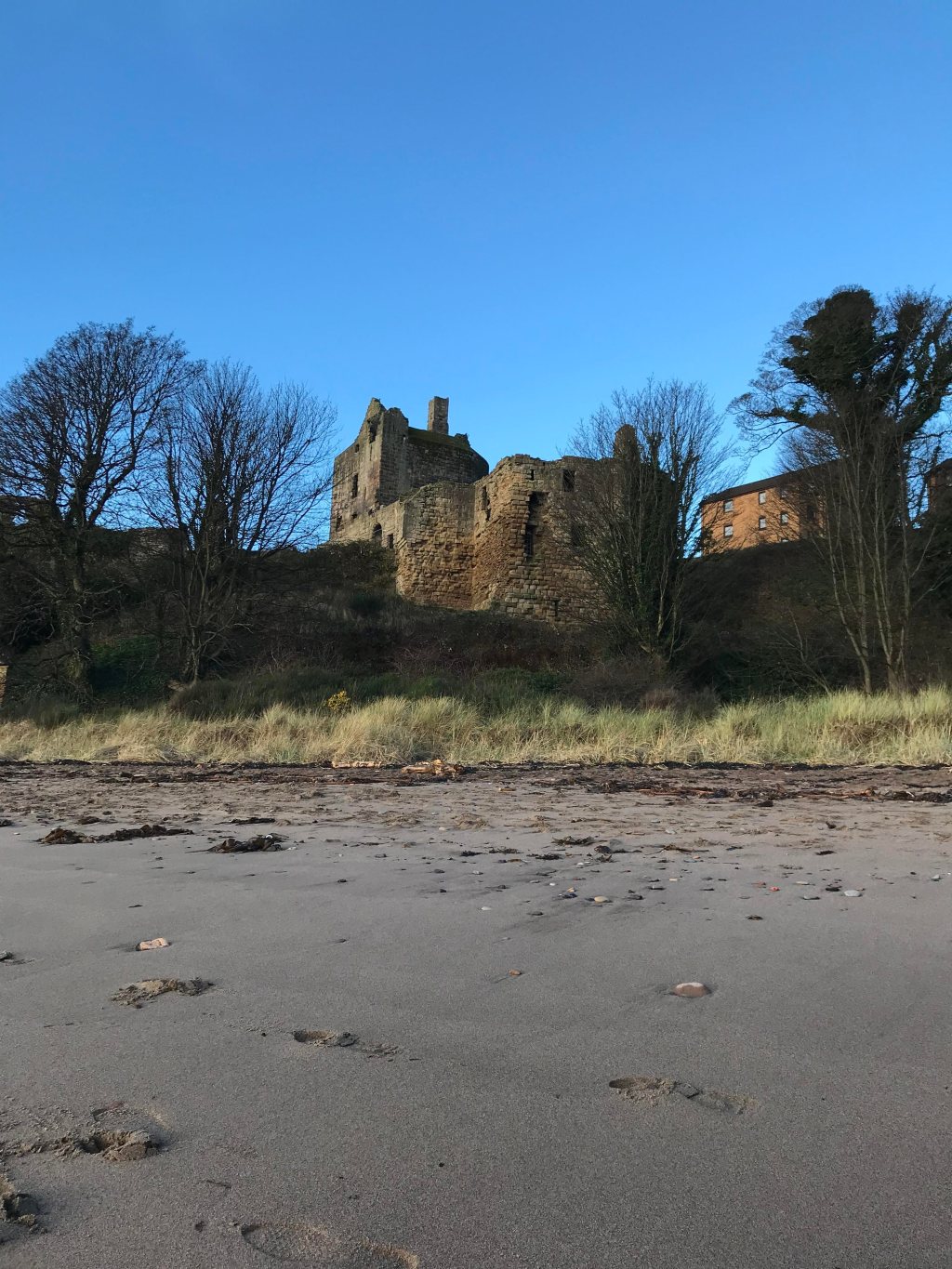
Once through Kirkcaldy’s last bastion of industry, a flour mill, I was onto the beach which is brooded over by the Ravenscraig Castle ruin and the much newer multi-storey flats. Both command the same view but occupants look to the water for different reasons. Beyond the beach, old castle walls demarcate little landing docks where castle booty was rowed ashore and spirited up to the waiting nobles.
There were couples and people with dogs out walking, all wrapped in hats, coats and scarves. Most were cheery this morning. On approach I’d feel self-conscious. Seeing a crowd or a couple coming the opposite direction I’d glance off to the left or right, pretend to look at something, then look back at them when we were steps away, smiling to show my lack of ill-will, and issue a greeting. This was returned, often with gusto, comments on the weather were provided, appropriate to a stable winter’s morning and a town which was once a nest of Scottish Industrialists.
Through a cave-tunnel I entered Dysart, so named for desert, by monks who came here seeking solitude in imitation of the Christian desert fathers. Another reason for choosing the site was maritime transport. Boats still fill Dysart harbour, bobbing on its petrol-green water. On the stone pier, men in hunting gear stood by vans smoking and chatting. I moved through the scene. A closed visitor centre, some old fishermen’s cottages with heritage plaques then further along and up a bit, a housing estate where the real people lived.
Here a monument stood for the miners. By Dysart is an old pit which was 2 miles deep, owned by the Wemyss family. Bings and winding gear are still visible on the cliff. Down on the beach I found a lump of coal. Shaled in layers, a dull black, I pocketed it. The path passes through new industry, cavernous warehouses emitting banging and an echoey radio playing pop, separated from the path by steel fencing. Would this industry be remembered when it is gone?
The Wemyss name remains on the coast. I stopped in West Wemyss to take the sun and then East Wemyss to eat my packed lunch. There was nobody about, I was content with my progress, the simple goal, the ease and leisure. I photographed a Buddha in a garden in West Wemyss, wondering who lived there, hoping they’d appear.
The next stretch had cavernous caves with Pictish etchings and on a cliff was the crumbling sandstone ruin of Macduff’s castle. Beware Macduff! A sign read; well not quite, beware falling masonry, it said.
Beyond this I looked down to a large housing scheme on a promontory: Buckhaven. I felt anxious approaching, that a pack of neds might set on me. The housing was as miserable as housing can be but their view out to the firth was as spectacular as any sea view. Whales swim here. The low winter sun was already setting, giving a silver reflection on the water. The path skirted right along the edge of the great point. Alongside it heritage boards told how Buckhaven was: a fishing harbour and a tourist town, until coal. Like the Wemyss villages, it was bereft of people.
My only human contact was with a fantastic voice coming from the huts of the sea-anglers’ club, a shanty of cabins and caravans. Most had chimneys and a jumble of small boats and nets and creels out front. The small, self-contained village was enclosed by a fence with signs which said: members only. It was from this warren of muddy alleys and nets the voice emanated. The stentorian voice of a leader, unshakeable, a voice for organising revolution. As I got closer, I overheard the issue was the length of a fishing line. There had been an injustice. There was an enemy. Someone who had wronged not just the speaker, but his audience. His words were rousing, a call to arms! As I passed I glanced between the huts and saw him, an enormous man with just a single acolyte holding a fishing wire. ‘Alright Son!’ he boomed at me, somehow catching my glance, ready to give answers to questions, even if I had none.
The path took me away from Buckhaven to Methil. Schools were coming out. Parents sat in cars staring at the school gates like eager dogs. Older children whizzed past on scooters. A man on a bicycle was booming out music on an Mp3 speaker. There was a determined dignity through Methil. Chipboard houses had neat gardens, dilapidated ones had shiny new Mercedes in the drive. Many shops were closed or on the brink. A shop front called Treble Taxis had a hatch onto the street – it was a square which had been sawed, the lines weren’t straight. Looking through it I saw a woman wearing glasses and remonstrating on the phone. Adjoined to her office was a smoky-looking waiting room. Several plastic chairs and a tower of old paperbacks, an unshaded bulb hung from the ceiling. All the stories which must play out in that place. I felt the pull but had no reason to order a taxi.
I was on a walk and reaching my destination. Leven Welcomes You, a sign said. I had been aware the coastal path was now away from the coast and the orange sunset hidden by buildings. But beyond Leven was a full moon hanging above one of Fife’s low hills, Largo Law.
I went to Starbucks and had a white hot chocolate, wrapping my hands around the warm mug and watching a pretty girl who served me. Soon I was in the bus station, groups of boys riding on dirt bikes, bus cancellations, an uncertain edge in the air. This is beautiful Scotland: Jekyll-Hyde, not letting you get too romantic. I took a bus to Glenrothes, turning my phone on. The first message was from the garage, informing me my bill for the van service was £1300. As we navigated roundabouts and estates into Glenrothes, I opened my journal for some Emerson wisdom.
In the presence of nature a wild delight runs through a man, in spite of real sorrows.

 Bardo travel: Writings on experience and place
Leave a comment